Six authorities, one sentence each
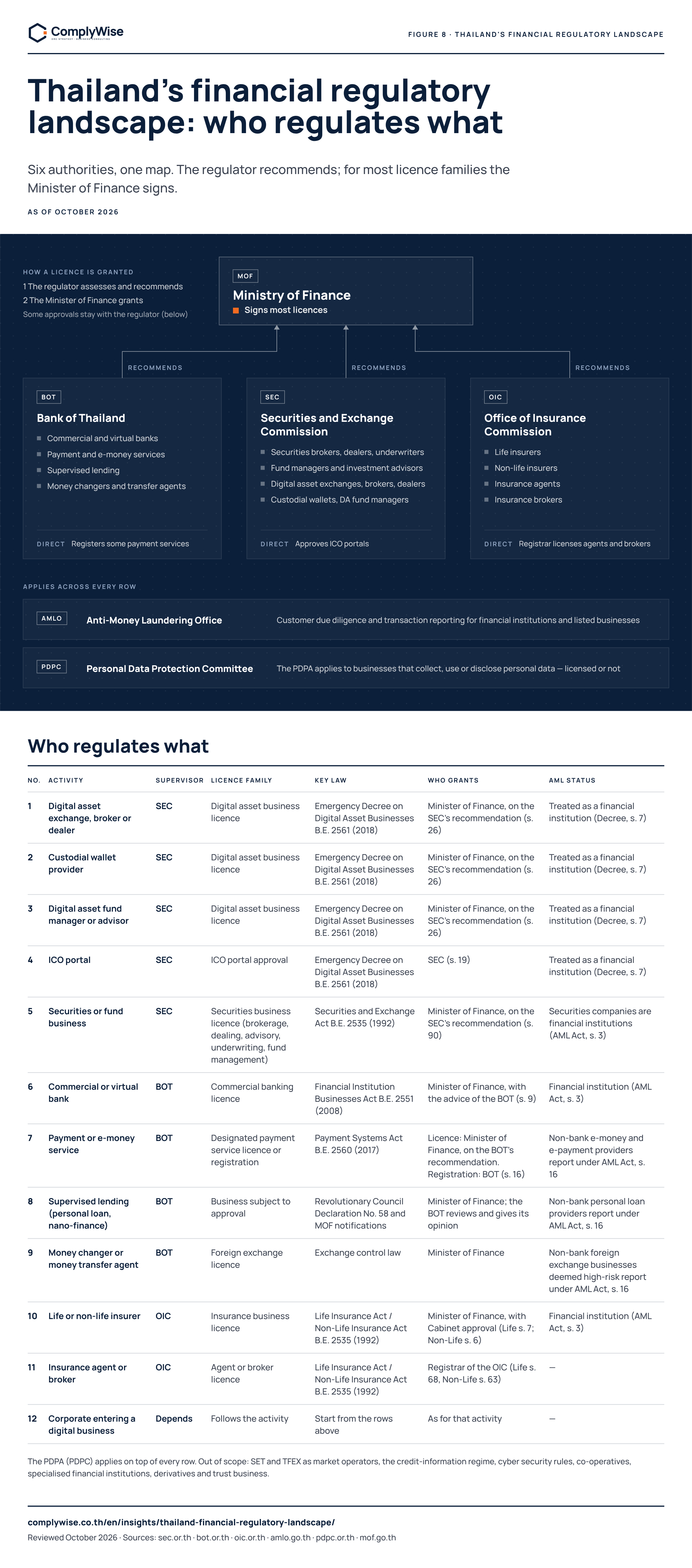
- MOFThe Ministry of Finance (MOF) grants most financial licences, acting on the recommendation of the sector regulator.
- BOTThe Bank of Thailand (BOT) supervises commercial and virtual banks under the Financial Institution Businesses Act B.E. 2551 (2008), payment and e-money services under the Payment Systems Act B.E. 2560 (2017), supervised lending and foreign exchange businesses.
- SECThe SEC supervises securities and fund businesses under the Securities and Exchange Act B.E. 2535 (1992) and digital asset businesses under the Emergency Decree on Digital Asset Businesses B.E. 2561 (2018).
- OICThe Office of Insurance Commission (OIC) supervises insurers, insurance agents and brokers under the Life Insurance Act and the Non-Life Insurance Act B.E. 2535 (1992).
- AMLOThe Anti-Money Laundering Office (AMLO) supervises anti-money laundering duties under the Anti-Money Laundering Act B.E. 2542 (1999).
- PDPCThe Personal Data Protection Committee (PDPC) supervises data protection under the Personal Data Protection Act B.E. 2562 (2019), fully in force since 1 June 2022.
Figure 8Thailand's financial regulatory landscapeThe regulator recommends; for most licence families the Minister of Finance signs. AMLO's duties and the PDPA apply across every row. As of October 2026. Download the full figure with the table (PNG)
Who regulates what?
Start from the activity your business carries out. Each row names the supervisor, the licence family, the law it comes from and who grants it. Rows follow the eight business types in our licence path finder, plus banking, foreign exchange and insurance.
| No. | Activity | Supervisor | Licence family | Key law | Who grants | AML status |
|---|---|---|---|---|---|---|
| 1 | Digital asset exchange, broker or dealer | SEC | Digital asset business licence | Emergency Decree on Digital Asset Businesses B.E. 2561 (2018) | Minister of Finance, on the SEC's recommendation (s. 26) | Treated as a financial institution (Decree, s. 7) |
| 2 | Custodial wallet provider | SEC | Digital asset business licence | Emergency Decree on Digital Asset Businesses B.E. 2561 (2018) | Minister of Finance, on the SEC's recommendation (s. 26) | Treated as a financial institution (Decree, s. 7) |
| 3 | Digital asset fund manager or advisor | SEC | Digital asset business licence | Emergency Decree on Digital Asset Businesses B.E. 2561 (2018) | Minister of Finance, on the SEC's recommendation (s. 26) | Treated as a financial institution (Decree, s. 7) |
| 4 | ICO portal | SEC | ICO portal approval | Emergency Decree on Digital Asset Businesses B.E. 2561 (2018) | SEC (s. 19) | Treated as a financial institution (Decree, s. 7) |
| 5 | Securities or fund business | SEC | Securities business licence (brokerage, dealing, advisory, underwriting, fund management) | Securities and Exchange Act B.E. 2535 (1992) | Minister of Finance, on the SEC's recommendation (s. 90) | Securities companies are financial institutions (AML Act, s. 3) |
| 6 | Commercial or virtual bank | BOT | Commercial banking licence | Financial Institution Businesses Act B.E. 2551 (2008) | Minister of Finance, with the advice of the BOT (s. 9) | Financial institution (AML Act, s. 3) |
| 7 | Payment or e-money service | BOT | Designated payment service licence or registration | Payment Systems Act B.E. 2560 (2017) | Licence: Minister of Finance, on the BOT's recommendation. Registration: BOT (s. 16) | Non-bank e-money and e-payment providers report under AML Act, s. 16 |
| 8 | Supervised lending (personal loan, nano-finance) | BOT | Business subject to approval | Revolutionary Council Declaration No. 58 and MOF notifications | Minister of Finance; the BOT reviews and gives its opinion | Non-bank personal loan providers report under AML Act, s. 16 |
| 9 | Money changer or money transfer agent | BOT | Foreign exchange licence | Exchange control law | Minister of Finance | Non-bank foreign exchange businesses deemed high-risk report under AML Act, s. 16 |
| 10 | Life or non-life insurer | OIC | Insurance business licence | Life Insurance Act / Non-Life Insurance Act B.E. 2535 (1992) | Minister of Finance, with Cabinet approval (Life s. 7; Non-Life s. 6) | Financial institution (AML Act, s. 3) |
| 11 | Insurance agent or broker | OIC | Agent or broker licence | Life Insurance Act / Non-Life Insurance Act B.E. 2535 (1992) | Registrar of the OIC (Life s. 68, Non-Life s. 63) | — |
| 12 | Corporate entering a digital business | Depends | Follows the activity | Start from the rows above | As for that activity | — |
Who actually grants the licence?
Thailand runs a two-signature system. The regulator assesses the application and recommends; the Minister of Finance grants the licence. Securities businesses (Securities and Exchange Act, section 90), digital asset businesses (Emergency Decree on Digital Asset Businesses, section 26), commercial banks (Financial Institution Businesses Act, section 9), licensed payment services (Payment Systems Act, section 16) and supervised lending all follow this route. Foreign exchange licences are also granted by the Minister of Finance, and insurers need the Minister's licence with Cabinet approval (Life Insurance Act, section 7; Non-Life Insurance Act, section 6).
Some approvals stay with the regulator itself. The SEC approves ICO portals (Emergency Decree, section 19). The BOT registers certain payment services instead of licensing them. The OIC's Registrar licenses insurance agents and brokers.
The route sets the timetable. For an e-money licence, the BOT's public handbook allows 60 business days: the BOT's review, with AMLO and SEC checks running in parallel, then the Ministry's consideration.
Which regulator licenses a digital asset business in Thailand?
The SEC. Digital asset exchanges, brokers, dealers, custodial wallet providers, and digital asset fund managers and advisors are licensed by the Minister of Finance on the SEC's recommendation; ICO portals are approved by the SEC. Since April 2025 the Emergency Decree states that it also covers operators abroad that serve people in Thailand, judged by factors such as Thai-language content, a Thai domain or Thai baht payment options (section 26/1).
See also: Which SEC digital asset licence fits your business model?
SEC or BOT: how do I know which applies?
Follow what the business does, not what the product is called. If it deals in securities, manages funds or handles digital assets, the SEC applies. If it moves or holds money for others — cards, e-money, payment acceptance, fund transfers, foreign currency — or lends under supervision, the BOT applies.
Many models touch both, and each activity needs its own licence or a licensed partner. Deciding this early shapes the company structure, the capital and the systems. Our licence path finder sorts the eight most common business types in three questions; the SEC and Bank of Thailand advisory pages set out what the application involves.
What applies to every licensed firm?
Anti-money laundering (AMLO). Banks, finance and credit foncier companies, securities companies and insurers are financial institutions under the Anti-Money Laundering Act (section 3); digital asset businesses and ICO portals are treated as financial institutions by the Emergency Decree (section 7). Several non-bank businesses — including certain e-money, payment, personal loan and foreign exchange providers — carry reporting duties under section 16. The core duties are customer due diligence from the first transaction onwards (section 20/1) and reporting cash, high-value and suspicious transactions (section 13).
Personal data (PDPC). The Personal Data Protection Act B.E. 2562 (2019), fully in force since 1 June 2022, applies to businesses that collect, use or disclose personal data, licensed or not. See PDPA for regulated firms.
The regulatory update series
Each update takes one recent change, places it on this map and says what it means for a business preparing an application. This page is the reference the updates point back to.
- 1
Crypto ETFs arrive in Thailand: one product, two rulebooks
- 2
Thailand's first virtual bank is open. Who signed its licence?
- 3
Thailand's Travel Rule for crypto transfers: where the SEC and AMLO meet
- 4
Buy now, pay later in Thailand: a licence of its own is proposed
- 5
A Thai baht stablecoin: the Bank of Thailand proposes two licences
- 6
Running a crypto exchange in Thailand without a licence: a criminal complaint, then a block
What this map leaves out
To stay readable the map covers licensing of the main financial activities. It does not cover the Stock Exchange of Thailand and TFEX as market operators, the credit-information regime, cyber security rules, co-operatives, specialised financial institutions under their own Acts, finance and credit foncier licensing in detail, derivatives business or trust business.
Frequently asked questions
- Who regulates banks in Thailand?
- The Bank of Thailand supervises commercial banks, including virtual banks, under the Financial Institution Businesses Act B.E. 2551 (2008). The licence to establish a bank is granted by the Minister of Finance with the advice of the Bank of Thailand.
- Who licenses payment and e-money services in Thailand?
- Under the Payment Systems Act B.E. 2560 (2017), card, e-money, e-payment acceptance and electronic money transfer services need a licence from the Minister of Finance on the Bank of Thailand's recommendation. Certain services register with the Bank of Thailand instead.
- Is a digital asset licence issued by the SEC or by the Ministry of Finance?
- Both are involved. The SEC assesses and recommends; the Minister of Finance grants the licence (Emergency Decree on Digital Asset Businesses, section 26). ICO portals are the exception: the SEC approves them itself (section 19).
- Do foreign digital asset platforms need a Thai licence?
- Since the April 2025 amendment, the Emergency Decree states that it covers operators abroad that provide services to people in Thailand. Section 26/1 lists factors such as Thai-language content, a Thai domain, Thai baht payment options or local support staff.
- Who regulates insurance in Thailand?
- The Office of Insurance Commission. Insurers need a licence from the Minister of Finance with Cabinet approval under the Life Insurance Act and the Non-Life Insurance Act B.E. 2535 (1992); agents and brokers are licensed by the OIC's Registrar.
- Who licenses money changers and international money transfer agents?
- These are foreign exchange licences under the exchange control law. The Bank of Thailand states that they are granted by the Minister of Finance, and the Bank of Thailand supervises the licensees.
- Does the PDPA apply to licensed financial firms?
- Yes. The Personal Data Protection Act B.E. 2562 (2019), fully in force since 1 June 2022, applies alongside sector rules. Firms also keep records under financial regulation, so retention periods have to reconcile both.
Sources
- Securities and Exchange Act B.E. 2535 (as amended), s. 4 (unofficial SEC translation)
- Securities and Exchange Act B.E. 2535, s. 90 and s. 117
- Emergency Decree on Digital Asset Businesses B.E. 2561 (as amended to No. 2 B.E. 2568), s. 3 (unofficial SEC translation)
- Emergency Decree on Digital Asset Businesses, s. 7
- Emergency Decree on Digital Asset Businesses, s. 19
- Emergency Decree on Digital Asset Businesses, s. 26 and s. 26/1
- SEC — Digital asset: list of licensed / approved operators (categories)
- BOT — Thailand financial institutions and financial service providers
- BOT — Laws and rules in BOT's responsibility
- BOT — List of successful applicants approved by the Minister of Finance to establish a virtual bank (19 Jun 2025)
- MOF Notification under FIBA s. 9 — establishment of foreign commercial bank subsidiaries (7 Jun 2013)
- MOF Notification: Stipulation on Designated Payment Services (17 Apr 2018), under Payment Systems Act s. 16
- BOT Public Handbook — Licence to provide e-money service (60 business days; AMLO and SEC checks in parallel)
- MOF Notification: Personal loan business under supervision (30 Jul 2020), clauses 3–4
- BOT — Types of foreign exchange licences
- Life Insurance Act B.E. 2535 (as amended), s. 7 (unofficial OIC translation)
- Life Insurance Act B.E. 2535, s. 5, 68, 70, 73
- Non-Life Insurance Act B.E. 2535 (as amended), s. 6 (unofficial OIC translation)
- Non-Life Insurance Act B.E. 2535, s. 63
- AMLO — AML/CFT laws, policy and measures
- Anti-Money Laundering Act B.E. 2542 (consolidated), s. 3, 13, 20/1 (unofficial AMLO translation)
- Anti-Money Laundering Act B.E. 2542, s. 16
- PDPC — Personal Data Protection Act, B.E. 2562 (2019)
- DLA Piper — Thailand postponed the implementation of the PDPA until 1 June 2022 (news or commentary)
- DFDL — Thailand's digital asset law amended to clarify extraterritorial reach (12 Apr 2025) (news or commentary)
Accessed and last reviewed . Each figure and table cell is traced to a source above.